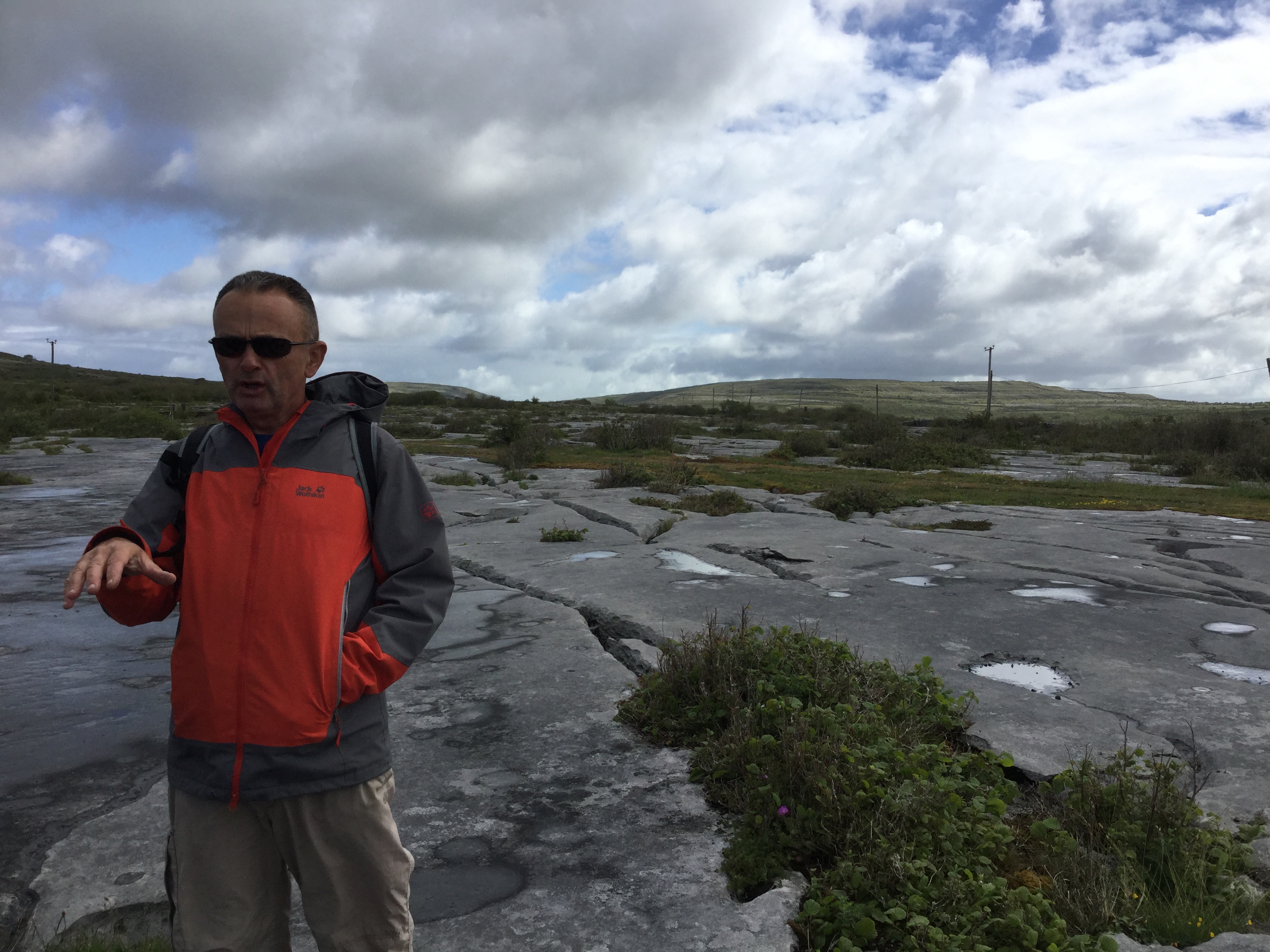
It was a rainy morning heading to the Burren. It was a day to explore the landscape and the people who have populated it throughout history. Our very knowledgeable and excellent guide, Tony Kirby, led us through the landscape with humor and humility, offering insights about the rural religion of Ireland, the role of colonization and foreign religions in the life of Ireland’s people.

Our guide in the Burren 
The trail? 
Fields for grazing 
Limestone 
stone fences 
the way through the fence…one at a time
The Burren itself is remarkable place. beautiful meadows, hills and valleys. I’ts primary distinction is limestone. When the stone is wet it looks like pools of water. It’s slippery as you hike across. The weather can change in a moment – sun, wind, mist, rain. Stone fences break up the oceans of green. Trails are challenging to follow, if there is even a trail there at all. It’s difficult to see the way through the wall until you are right there. Waymarkers help pilgrims find the way.
Our first stop was the abandoned house of a poor Irish family. Made completely of stone, only one room, which could accommodate 10 or more people. A central fire, but no chimney. The hearth fire was the heart of the Irish rural home, and important in their religion. The fire served four purposes: Light, heat, cooking, and connection. It was believed that after the family went to sleep, the ancestors and fairies would gather around the fire to converse.

Tony told us how to recognize who built any given fence. Poor Irish were often “employed” as slave labor to build fences for the English. You can see some below. Sometimes the workers were paid, often they were not. The average lifespan for a man in Ireland in the 17-1800’s was 29. Under British rule, they suffered greatly and by the time of the “great hunger” in 1845, Ireland lost 3 million people – 1 million to starvation, 2 million to emigration.

mostly horizontal stones, post-1600, a deer park fence to keep deer inside for hunting 
Earliest wall, property boundary, before 1600. 
opposite the first wall, to mark the path for pilgrims to the temple – horizontal stones on bottom to keep lambs in, vertical stones on top to keep sheep from jumping the fence.
We walked along between the stone fences toward St. Cronan’s Temple, a way that hundreds, maybe thousands of pilgrims had walked before. But also a path, created by walls of colonialism and suffering.

We arrived at the Temple ruins in the rain. A humble landscape, on the slope of a hill. I could see the foundations of old buildings, the remains of a once thriving village, with the temple at the heart. St. Cronan founded the community in the 11th century.The boundary of the community was once marked with 4 high crosses and a large cairn indicating the four directions. Only the base of one high cross remains, directly in sight of the temples front door. The temple is 21 ft x 15 ft, but could hold up to 90 people (different cultural norms about personal space).

waymarker 
remains of village 
church from outside the wall 
original front door 1.3 meters high- later sealed up by Augustinians and a new North-facing door added 
Inside the temple – only one small window 
South side of church – roof would have been thatched 
container for relics and cemetery up unmarked graves
The experience of the church would have been a very different experience than we have today. Worshipers would have left the light of the outdoors and entered into the mysterious darkness of the church. One small door and one East-facing window. It represented the mysterious nature of God, and must have been awe (and maybe fear) inspiring.
I was deeply moved and disturbed by the grave site. There was a holy burial area for people in the village who had been baptized and monks serving the community. This particular grave are was for the unbaptized – infants who died in childbirth, women who were “unchurched”, sailors lost at sea whose baptism could not be proved and the mentally impaired. How do we reconcile ourselves with our Christian kin who held these beliefs, which undoubtedly hurt people. I found myself weeping for those people as I stood on their grave. What did community mean for them?
We then made our way to the holy well. Wells hold a special place in the faith practice of Ireland. There are holy wells all over, and people are drawn to them for healing and hope. The practice is to walk around the well 3 times in the sun-wise direction, and then to make an offering, or engage in some other ritual with the water. often people will leave a ribbon as a sign of gratitude. Others will bring clothes to dip in the water to take home for healing. Our group of pilgrims sang a song of blessing, walked in a circle three times. As we did the skies opened up and poured down rain. It felt like a cleansing. When it was my turn at the well, I knelt down, and dipped my fingers in the water, made the sign of the cross on my forehead, and remembered my beloved-ness and pray for the souls who beloved-ness was denied at that church.

pilgrims on the path to the well 
the well is in the rock at the bottom of the picture