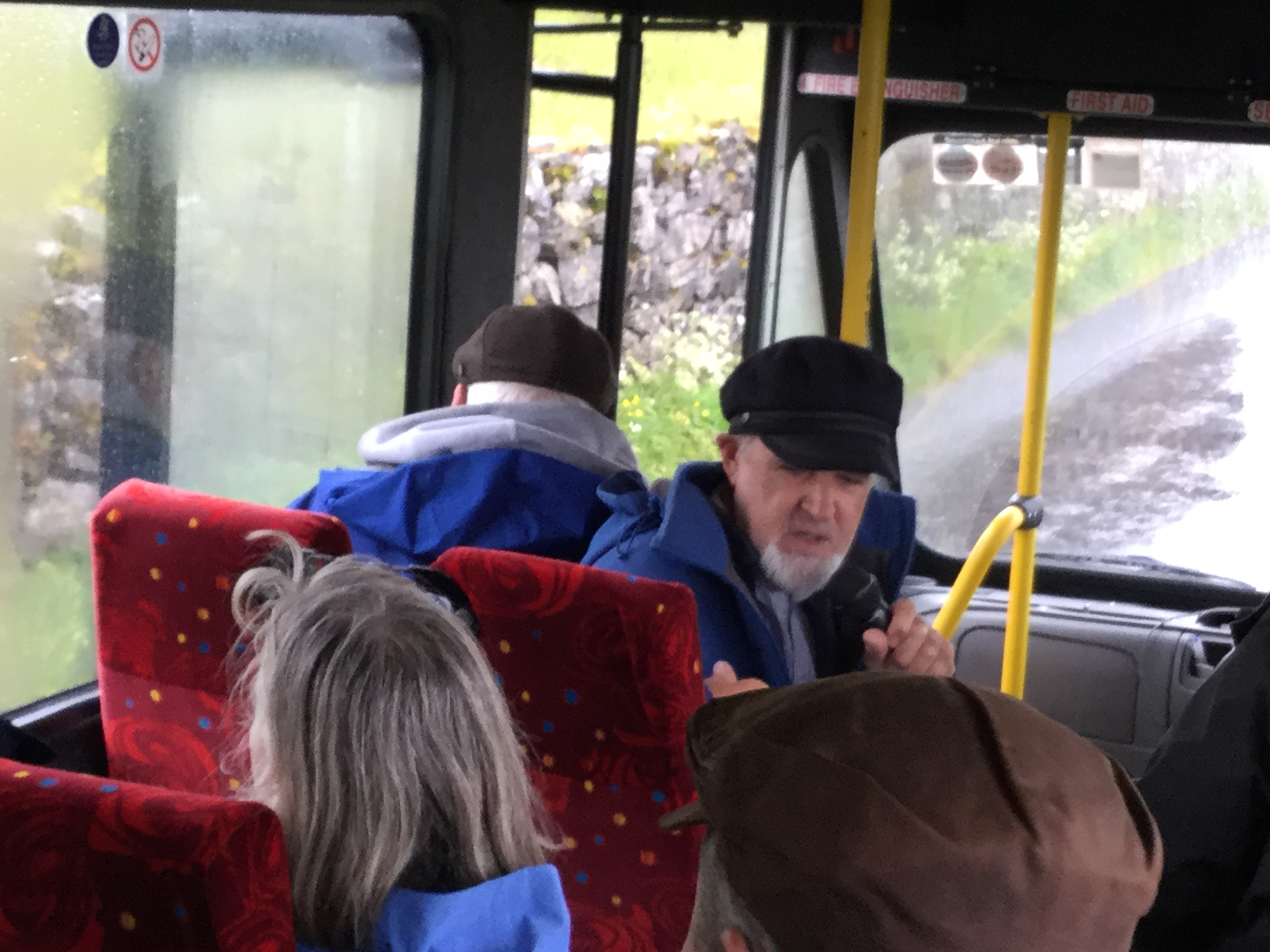
After a day of Sabbath we set out for the Aran Islands. The largest island is called Inis Mor – literally the big island. The ferry journey was a bit wild and we were all glad to reach solid ground. We were met by Dara Malloy, a Celtic priest at-large, who lives on the island.
We headed straight away to the tiny village of Kilmurvey, an artist’s community. We had lunch, visited a couple of shops and then were back on the bus. We drove past thatched-roof houses (the one pictured has a tiny house for fairies and leprechauns). Here on the island, the Christian imagination is deeply formed by Druid traditions and rural folklore and myth. The Celtic cross itself was developed from an ancient druid symbol.


Our first stop was Na Seacht dTeampaill (Seven Churches). You can find out more here: http://www.aranislands.ie/na-seacht-dteampaill-the-seven-churches/ . It is a multi-period church beginning with the first church in the 8th century and the grounds going through many changes through the years, all the way up to the Reformation, when Henry VIII shut down all the catholic churches in Ireland.
In the pictures below you can see the grounds, the church sanctuary, graves, high crosses, foundations of smaller buildings, and a baptismal pool with the remains of a high Cross, featuring Jesus and the two men crucified with him. The pool would have been used for pilgrims who made the long journey to the site and for locals who were baptized, usually on Easter.


From there we journeyed on the St. Ciaran’s well and church. Born in 512, he studied on the mainland, and then wit St. Enda, a prominent monk and teacher whose church is on Inis Mor. The practice was for monks to leave their community and find a new location to form a new community. The norm was for a community of monks to include an abbot and 12 monks, modeling Jesus and the 12 disciples. St. Ciaran was charismatic and his community grew on this site. He eventually left, returning to the main land and beginning another very successful monastic community in Clonmacnoise.
St. Ciaran’s holy well is close to the church. There is also a “rag tree” (May bush) for people to tie blessings and prayers onto. The ritual at this well was to take 7 stones from the stone bowl, and as you walk sun-wise around the well, and pray (Catholics would pray the rosary 7 times), dropping a stone in back in each time around. Then we entered the well area, which was overflowing because of so much recent rain, and dip our fingers in the water to bless or anoint ourselves.
The site also includes a sundial. A small pole would have been inserted in the top for casting a shadow. The column was also later used as a contract stone – people would stand on either side, work out their deal, and touch fingers through the hole, thus sealing the deal int he eyes of God. It is also used as a wishing stone by inserting a scarf or cloth into the hole three times and then making a wish.


