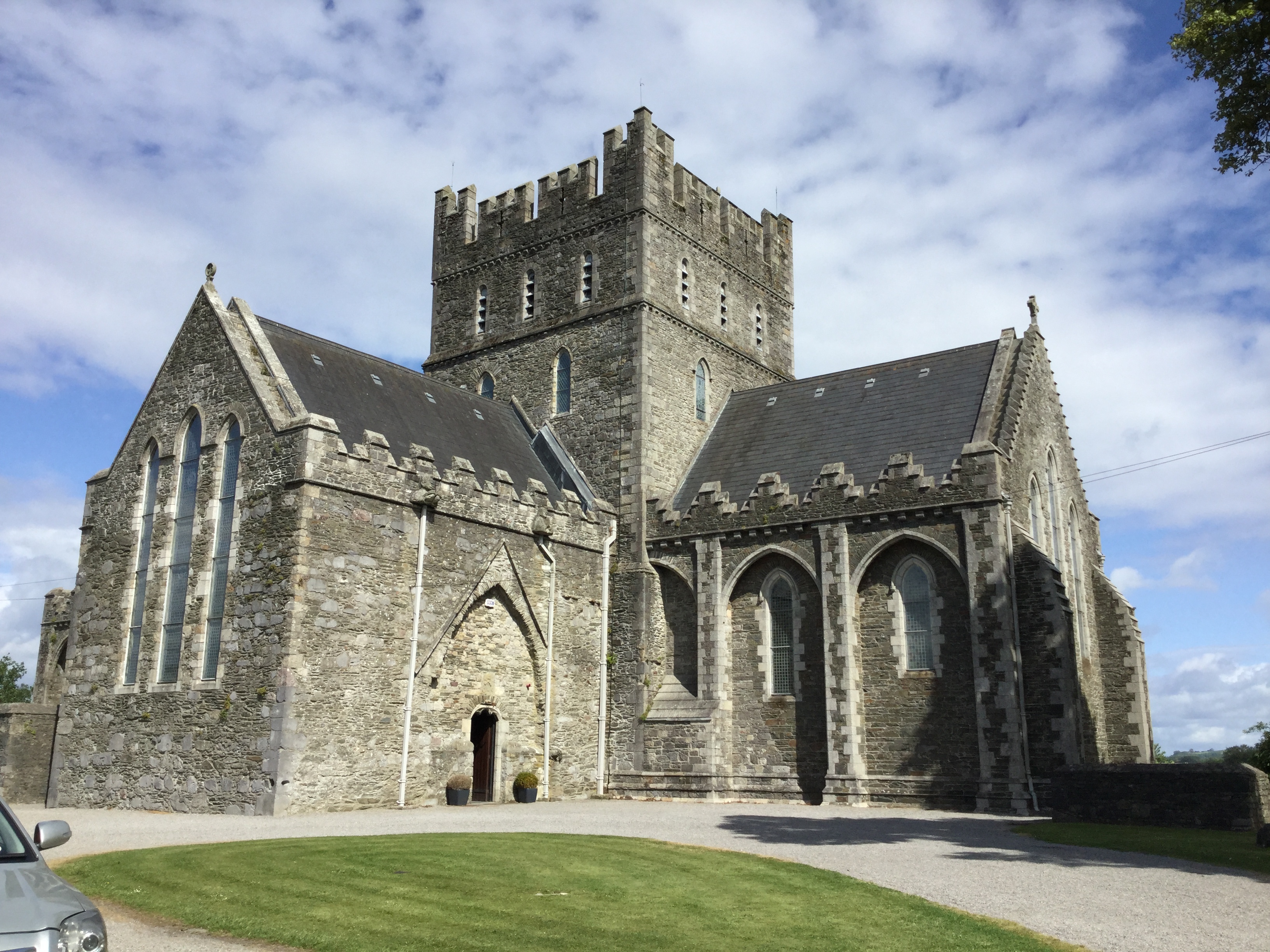

St. Brigid’s Cathedral 
Statue of St. Brigid near a holy well 
St. Brigid’s flame – statue in Kildare town square
Kildare town was one of the most fascinating places I’ve been so far. I didn’t expect that, but such is the pilgrim experience, surprises round every corner.
The town itself is quite small, a village, really. Dropped in the middle of the Curragh (plains) it is situated on the site of St. Brigid’s original 5th century monastic community, Cill Dara, or church of the Oak because of it’s proximity to a mighty oak tree.
Over time the pagan goddess Brigid and the Christian Saint Brigid became one in the same. This was the way of Christianity in Ireland, not to reject and destroy the existing religion, but to find resonances between pagan and Christian belief and ritual, weaving them together intimately.
The stories about Brigid run through civic and religious life here. Everyone seems to know them. The fire temple at her monastery kept a perpetual flame (a remnant of pre-Christian worship and practice), and so in the town square you see a sculpture of that flame. The Brigidine sisters at the Solas Bhride Center (where I stayed) have re-lit and now tend this flame. The original flame is believed to have been extinguished when the monasteries were closed during the reformation. Each year the fire is re-lit in the town center during the feast of St. Brigid.
I find myself struggling to think of a place like this in the States. Our country is in its infancy compared to Ireland, but our lack of sacred space is in part the result of the doctrine of discovery and its role in the American religious imagination. Missionaries in America did not cooperate with the Native peoples, they labeled their religions “savage” and destroyed them. But I am wondering, more than ever, what richness might result from an embrace of native belief and ritual? Where are our sacred sites? How do we nurture this deep relationship with place and history?

Brigid’s well and garden 
pool for beginning prayer 
5 prayer stones between 
round well 
rag tree 
stream in garden 
Brigid’s wayside well 
view of steps into well and rag tree
The sisters of the Solas Bhride center were lovely hosts. I stayed in a hermitage – one of three – which are named faith, hope, and love. I occupied “hope” during my stay. It is a place dedicated to the tradition of Brigid: care for the earth, justice and peace, and the cultivation of sacred space. It provided a quiet and welcoming space for me after my pilgrimage, to do some integration while I was exploring the town. The building itself is in the shape of Brigid’s cross, and the sisters – Phil, Mary and Rita – were gracious hosts with whom I enjoyed many deep conversations over tea.

Art in Solas Bhride 
Brigid’s Cross wall hanging 
Brigid’s cloak 
Solas Bhride Center 
St. Brigid statue in garden 
Stone labyrinth 
hermitage – circular, based on Brigid’s cross 
inside hermitage 
cozy fire
Many monastic communities in Ireland built round towers. This was a place that served as a lookout, but also a ‘secret storage’ for relics and important artifacts when Vikings and Normans attacked. The round tower at St. Brigid’s cathedral is the second tallest round tower still standing in Ireland – 90+ meters high. So, I took the opportunity to climb it!

The round tower 

a series of steep ladders and small openings 
view from window about half way 
a little farther up 
opening on the top 
stunning views from the top 

The arch over the pool and the round tower are so cool! Thanks again for the lovely pictures.
“Stunning” is the right word. Thank you!
Wow. Love this kind of history.