My last stop on my individual pilgrimage in Ireland was the city of Armagh. This necessitated a trip north into Northern Ireland, technically a different country. The transition was very easy, and the people and towns very similar to the Republic of Ireland.
Armagh is St. Patrick’s city. There are two St. Patrick’s Cathedrals on opposite ends of town – one Church of Ireland and the other Roman Catholic. He belongs to them both, and that seems to be just fine for everyone. It got me thinking about the year in seminary when I took a course on the history of Christian Spirituality. Having grown up in the conservative Lutheran church, it seemed to me that Christianity went from the apostles to Martin Luther. The class revealed to me centuries of Christians I had never known. Catholic and Orthodox theologians and mystics that more fully enriched my own spirituality. This ability to embrace multiple traditions is a characteristic I am discovering, is an essential part of the Celtic spiritual ethos.
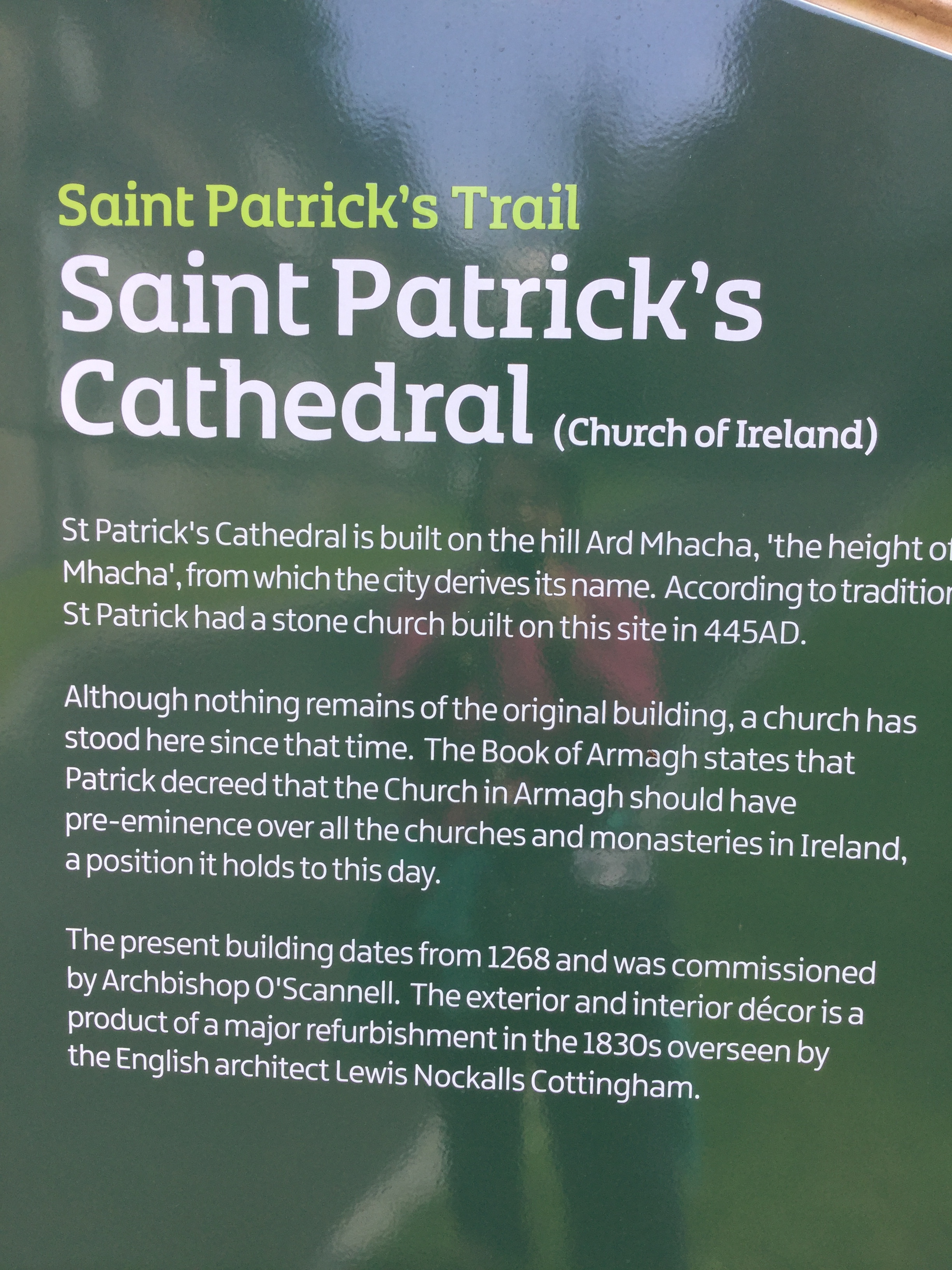
St. Patricks Cathedral, Church of Ireland cites Patrick as their first bishop. Patrick probably began his church in another location, but eventually, as he gained followers he negotiated with the local chieftain to move his church to the high hill of Ard Mhacha.


view of altar from choir 
main altar 
Lady Chapel behind main altar 
lady chapel statues – usually has a statue of Mary, but Jesus is center here 
from back of church 
COI churches very often honor the dead from the Great War 
Side chapel for Great War 
Great War Flags in side chapel 


view of cathedral from gardens 
meditative garden 
orchard garden
St. Patrick’s Cathedral (RC) is built on the site of a Patrick Legend. The cathedral that stands there now was begun in the mid-1800’s. It is much more ornate in decor than it’s Anglican sister church.


main entrance 
from back of church 
confessional 
main altar area – bishops chair 
main altar opposite side 
Lady chapel behind main altar 

on floor 
side chapel – Blessed Sacrament 

Orthodox icon of Holy Family 
floor mosaic of celtic knots 
decorative element in pews 
mosaic on wall 
mosaic – Life of St. Brigit 
mosaic – consecration of Brigit 
mosaic – St. Columba
St. Patrick’s COI and St. Patrick’s RC are both seats of their respective archbishop, so Armagh is considered the Ecclesiastical capital of Ireland. You can see the proximity (about 1/2 mile apart) of the two churches in the pictures below.

From front steps of St. Patrick’s RC, you can see the tower of St. Patrick’s COI 
view of St. Patricks – RC from outside the main gate of St. Patrick’s COI
“Ard Mhacha” – the Height of Macha -is the original Irish name of the town. Macha is an important name in the area, also connected with the Pagan sacred cite of Emain Macha. This site is now under the protection of the government (a World Heritage Site) and a museum and cultural center, The Navan Center, is caretaker. Macha is the legendary goddess of war and fertility (an interesting combination) who scored the earth with her brooch pin, designating the boundary of this sacred stronghold.
The mound, which is the central temple site, is difficult to see now, except from the air – pictures don’t do it justice. You can see in the pics below, the placard that describes the whole site, the lines of bushes demarcating the hill, the trench around it, and the ring barrow. In about 95 BCE, people from all of Ulster came together to build a temple, 40 m in diameter, with 5 concentric rings of timber. They filled the entire place with rocks and then lit it on fire. historians imagine that this was a massive offering to the God’s in a time of crisis and war. But no one knows for sure. Since that time, it has been revered as a holy site, the only one of it’s kind in Ireland, and perhaps the world.

Welcome sign at Navan Center 
Entry – green roof 
placard describing the site 
Trench behind the ring of bushes – not defensive, but a path for ritual walking 
ring of bushes around the temple site 
ring barrow – burial mound 
re-imagined pagan community 
interpretive center 
reenactors
The connection between Patrick and Emain Macha began when he was a slave, a shepherd, keeping sheep on the Slemish Mountain (legend says this is where he first experienced conversion). He would have known Emain Macha as the seat of Ulster’s kings and the home of Ulster’s most sacred temple. So, when he returned to Ireland to convert it to Christianity, he began to connect people with this new religion in the place of ancient Celtic Spirituality. He respected the existing sacred tradition and found ways to connect Christianity with the existing traditions and power structures. Contrary to the sense of American Christian orthodoxy, which seeks to establish the “right” way or belief, I have experienced Celtic Spirituality and Christianity in Ireland as one which can hold many differing stories and traditions without the need for one or the other to be “right.” There is a deep respect for all encounters with the divine, and appreciation for the gifts of many religious traditions.
How inspiring! “Contrary to the sense of American Christian orthodoxy, which seeks to establish the ‘right’ way or belief, I have experienced Celtic Spirituality and Christianity in Ireland as one which can hold many differing stories and traditions without the need for one or the other to be ‘right.’ There is a deep respect for all encounters with the divine, and appreciation for the gifts of many religious traditions.”